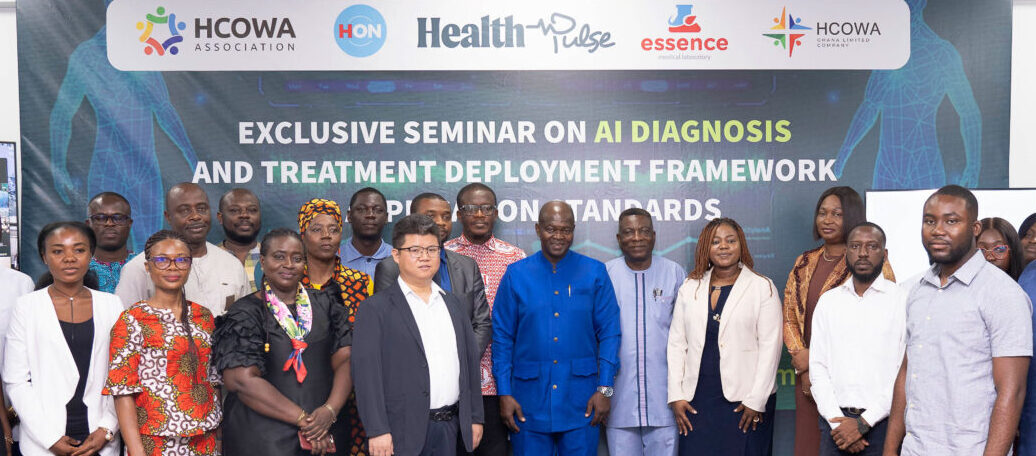
In the pursuit of developing a structured framework for the deployment of AI-driven diagnosis and treatment in healthcare, the Health Community of West Africa (HCOWA) Association hosted its second Stakeholder Engagement Seminar on AI Diagnosis and Treatment Deployment.
The seminar, held in Accra, Ghana, on February 21, 2025, brought together key stakeholders, including policymakers, medical professionals, industry leaders, and regulatory bodies, to discuss the integration of AI in medical decision-making.
Under the theme “Advancing AI Diagnosis and Treatment: Building a Framework for Healthcare Transformation,” participants explored strategies for standardizing AI applications, ensuring compliance with healthcare regulations, and strengthening international collaborations to enhance medical services across West Africa. The event served as a crucial platform for shaping policies, addressing challenges, and fostering innovation in AI-driven healthcare solutions.
AI as a Game Changer in Healthcare
Speaking at the seminar, Professor Samuel Kaba Akoriyea emphasized the transformative potential of AI in medical diagnosis and treatment. He highlighted AI’s applications in medical imaging and diagnostics, where technologies such as computer vision and neural networks enhance the analysis of imaging data from X-rays, CT scans, MRIs, PET-CT scans, ultrasounds, and pathology slides. AI-driven solutions have demonstrated the ability to detect conditions such as fractures, lung cancer, liver cancer, skin cancer, and intracranial aneurysms with remarkable accuracy.
“Your bold mission and key involvement in launching the HCOWA AI Treatment Project is one that the Ghana Health Service values greatly. AI is transforming the global healthcare landscape, and Ghana must not be left behind,” Professor Akoriyea stated.

Professor Samuel Kaba Akoriyea underscored the importance of developing a structured framework for AI diagnosis and treatment based on global best practices. He recommended adopting the UNESCO Recommendation on the Ethics of AI, known as the RAM Framework, to guide ethical AI integration in Ghana’s healthcare system.
“The RAM Framework provides a structured approach to AI ethics and governance, emphasizing fairness and inclusion, transparency and accountability, and security and ethical integrity,” he stated.
Professor Akoriyea stressed that AI systems should be designed to benefit all Ghanaians equitably, avoiding biases that could widen health disparities. He emphasized that AI-driven decisions must be explainable and subject to regulatory oversight to ensure fairness and justice. Furthermore, he highlighted the need for stringent security measures to protect patient confidentiality and prevent unethical data usage.
“These principles are key to advancing AI diagnosis and treatment in healthcare, ensuring that technology serves as an enabler of improved medical outcomes while upholding ethical standards,” he concluded.
He further stressed the importance of a structured AI adoption framework that ensures responsible AI use in medical decision-making. He noted that AI should complement rather than replace human clinical judgment, with healthcare professionals validating AI-driven diagnoses before implementation.
“We must ensure that AI serves as a tool to enhance, not undermine, the expertise of our medical professionals,” he added.
He also underscored the need for robust data protection measures to prevent AI misuse and bias, emphasizing compliance with Ghana’s data protection regulations to safeguard patient information.
HCOWA’s Role in AI-Driven Healthcare Transformation
Delivering a keynote address, Ms. Liu Suhua, Chief Secretary – China for the HCOWA Association, reiterated HCOWA’s commitment to fostering AI-driven healthcare transformation in West Africa. She highlighted the association’s role in bridging technological gaps, ensuring AI integration aligns with healthcare standards, and enhancing patient outcomes.
“The HCOWA Association is poised for transformative change in the healthcare industry. By establishing clear deployment frameworks and ensuring cross-border collaboration, we are setting the stage for AI-driven medical advancements,” she stated.
Economic and Social Benefits of AI Adoption
Touching on the economic potential of AI, Mr. Anthony Ameka, CEO of the Federation of Africa Medical Equipment Disposables and Devices Manufacturers and Suppliers, noted that AI is projected to add $15.7 trillion to the global economy by 2030.
He outlined how AI can stimulate economic growth, drive innovation, create new industries, and enhance job opportunities across Africa.
“AI can help solve some of Africa’s most urgent healthcare challenges, while also preserving cultural heritage and generating new business opportunities,” he noted.
Compliance and Ethical Considerations
Experts at the seminar underscored the importance of complying with regulatory standards set by the Health Facilities Regulatory Agency (HeFRA) and the Food and Drugs Authority (FDA). They emphasized that patient safety and ethical AI use should remain a priority to build public trust and ensure smooth integration into existing healthcare structures.
Strengthening International Collaboration
A key milestone of the seminar was the emphasis on international partnerships to enhance AI-driven healthcare solutions. Collaborations with leading institutions in China and across West Africa will foster knowledge exchange, technological advancement, and improved medical services in the region.
The Health Community of West Africa (HCOWA) Association has appointed key professionals to leadership roles to drive healthcare integration in the region. Dr. Paulina Denteh will lead as Director of Women’s Health & Wellness, focusing on maternal care and gender-specific health issues. Dr. George Henry Acquah, appointed as Director of Public Health and Policy, will spearhead evidence-based policies to enhance public health systems. Dr. Selina Leward, as Director of HPV Awareness and Preventive Care, will lead advocacy efforts on HPV vaccinations and screenings. These appointments reinforce HCOWA’s commitment to strengthening healthcare frameworks and improving medical outcomes in West Africa.
Strategic Plan for AI Implementation
The seminar concluded with a strategic roadmap for AI adoption in healthcare. The action plan includes compiling key seminar outcomes into an official document for stakeholder reference, followed by an extensive review and feedback process. Additionally, policymakers, medical institutions, and technology developers will be engaged to assess the findings and ensure a well-rounded approach to AI implementation.
Aligning the AI framework with regulatory guidelines from the Health Facilities Regulatory Agency (HeFRA) and the Food and Drugs Authority (FDA) is a crucial step in streamlining approvals. Moreover, actionable implementation plans will be developed, including training programs and structured deployment schedules, to equip healthcare institutions with the necessary tools for effective AI adoption.
To broaden its impact, the seminar allowed participation from healthcare professionals, policymakers, and AI experts across different regions. The event saw active engagement from Changsha (15 participants) and Chengdu (12 participants) in China, along with 15 attendees from Togo.
Conclusion
The second HCOWA Stakeholder Seminar on AI Diagnosis and Treatment Framework reinforced the urgent need for structured AI adoption in West Africa’s healthcare landscape. With growing collaboration between governments, private stakeholders, and international partners, AI is set to play a crucial role in transforming healthcare delivery across the region.
HCOWA remains committed to driving innovation and ensuring that AI technologies are deployed responsibly, ethically, and efficiently to improve health outcomes for all. The seminar marks a significant step forward in building a sustainable AI-powered healthcare ecosystem in West Africa.